In the old days of search, no one knew for sure what was in the Google search algorithm, it was a black box. Sure we had hunches, but the actual algorithm, and its ranking factors weren’t public. This created a lot of conjecture and a lot of room for thought leaders and influencers to publicly guess at the “secret sauce.”
Those early days of SEO were a lot of fun, but much of what lawyers learned from the good old days no longer applies in the AI era.
Google sent traffic to the open web, and organized content around rankings. Those days have passed, and now the focus is on AI search, or generative engine optimization (GEO).
Google-era SEO
AI-era GEO
GEO is more about citations and retrieval, than ranking a piece of content. Testing one or two searches in ChatGPT or Claude won’t give you an accurate view of whether you are winning AI search, and neither will referral traffic. As we will learn in this guide, the best way to understand AI search for lawyers is with a dedicated agent that can communicate with Gemini, Anthropic, and OpenAI via their open APIs to calculate your share of AI voice.
We get lawyers who ask us all the time, how do I get cited in AI search? ChatGPT, Gemini, and Claude are the big ones we’re asked most about.
Ask twice, get a different answer
Compiling · early dataDefinition
What is AI search for lawyers?
AI search for lawyers is the logical next step after the last two decades of Google Search. It’s the practice of building the websites and reputation profiles that make it easy for AI agents to surface your firm when someone asks about one of your areas of expertise.
The two types of AI searches for lawyers
First, let’s make a distinction between informational searches and transactional, or “buying” searches. While it can be beneficial for an AIO model to cite your blog as a lawyer for a research query, such as “what is the statute of limitations on a car accident claim in Illinois?”, generally, these are low conversion searches. Why?
Have a look at the screenshot below. In this case, the AI cites Illinois legal aid and summarizes the Illinois black letter law. There isn’t much opportunity for getting click through, the ecosystem is closed.
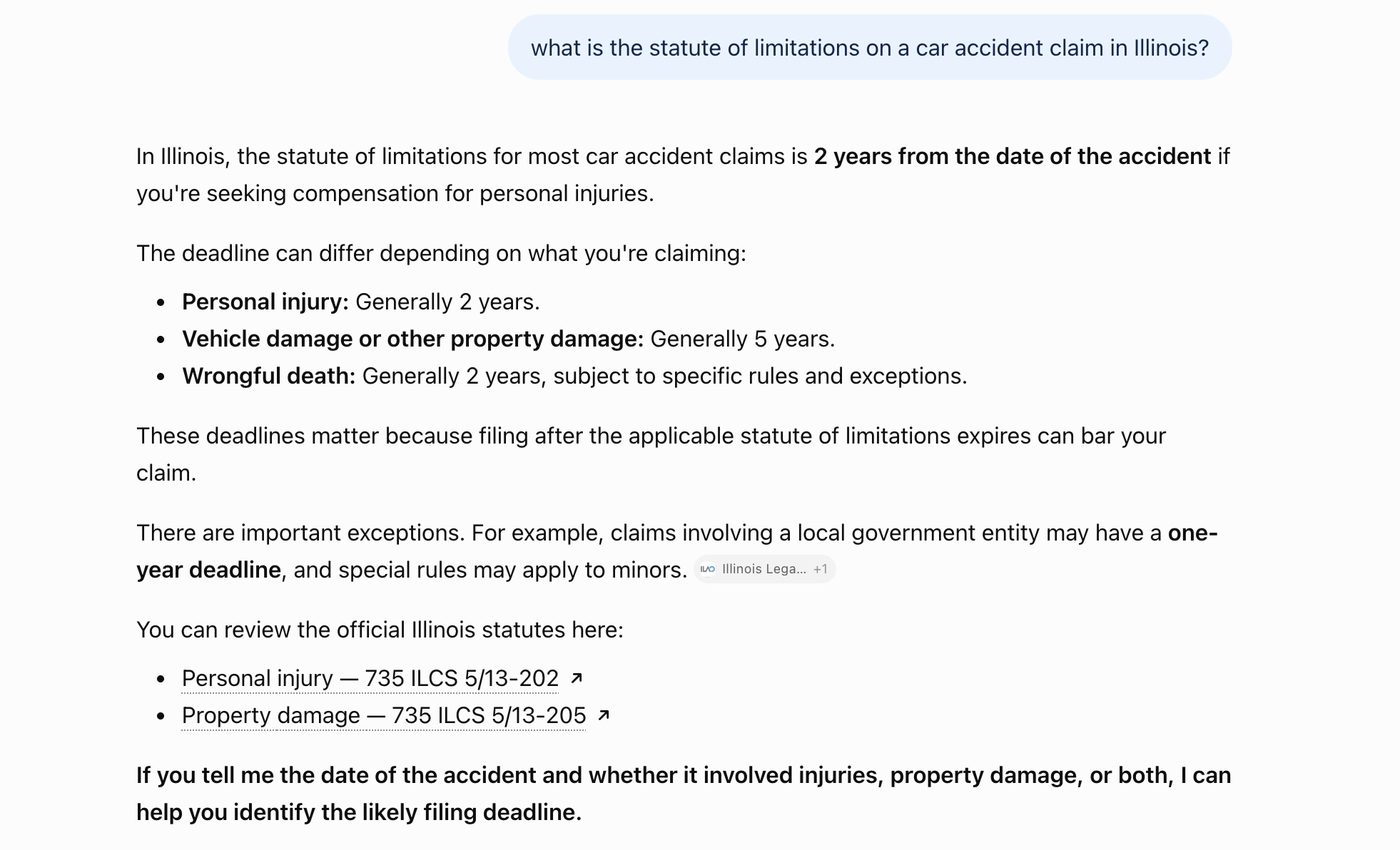
However, contrast this with “I am looking for a local lawyer” searches. In these cases, AI search is a powerful conversion opportunity for law firms who know how to play the game.
Contrast the UI on the buy-intent search versus the informational query. To keep pace with Google, and to satisfy the expectations of users with a carousel-like experience, the model now encourages hiring. The ecosystem is open and there for the taking.
In most of the AI models, we now have map style interfaces which mirror Google local. If you search Personal injury lawyer Los Angeles in ChatGPT, you see the traditional layout modeled after Google.
In a minute, I will tell you why spot checking rankings, as I just did, is a poor strategy for AI search, but first let’s observe why a given firm ranks first in ChatGPT for a search “Best injury lawyer in Los Angeles.”
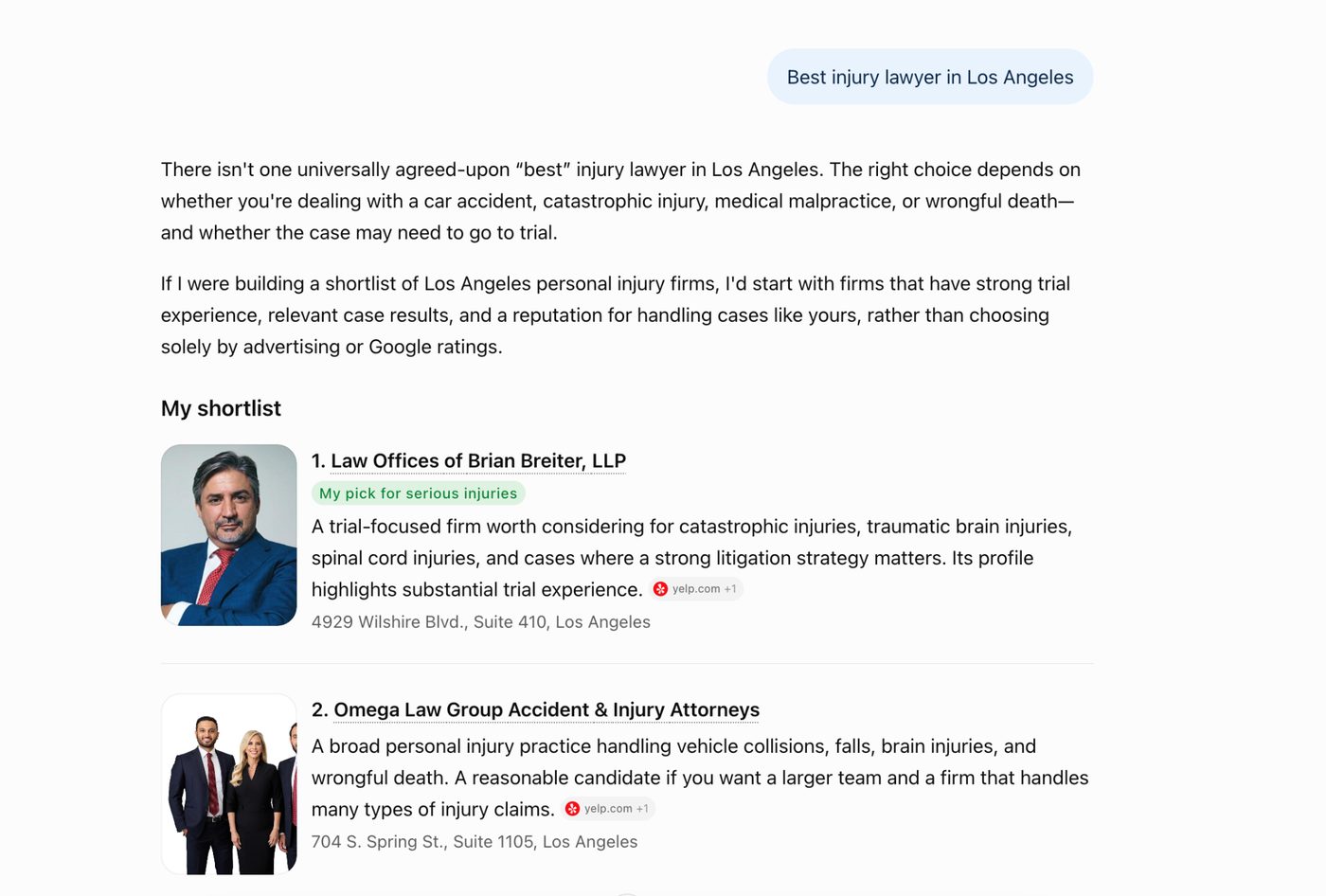
What is the law office of Brian Breiter doing here that wins them the top spot?
AI pulls from forgotten neighborhoods
They understand something about the web most law firms will never get. AI pulls from forgotten neighborhoods.
In this case, Yelp. Both top results are backed by strong Yelp profiles, and OpenAI is leaning on Yelp in this search. In fact, the top two results in ChatGPT for the best injury lawyer in LA have both emphasized Yelp.
But I thought Yelp was a dusty old site that no one visits any longer?
Largely true. Yelp had its day and is on the decline as a platform. But, it’s a treasure trove of data, reviews, and first hand accounts written by real people.
OpenAI crawls it, and trusts its mature pages. That, and ChatGPT and Yelp have announced partnerships for restaurant reservations, and other local data sources. Yelp is licensing its local data to OpenAI. So, guess what happens next?
ChatGPT starts heavily relying on Yelp profiles to surface local service business recommendations. If a law firm wants to rank in AI search, at least on ChatGPT, Yelp should be a priority.
Local SEO and GEO for lawyers overlap
Law firms hoping to rank in AI search can no longer be Google centric with their approach to reviews. It’s easy to concentrate the review process solely on Google, but AI labs competing with Alphabet won’t reward that approach.
As with Yelp, it’s critical to understand the sources of data from the web that the frontier labs use to gain local knowledge.
The GEO structure mimics the “name, address, phone” structure of local SEO. Google used a network of websites to corroborate the information businesses added to their Google local listings. When outside trusted sites told the same story about the business that the Google listing told, trust increased, and rankings improved.
With AI search, the game is more about reputation than NAP consistency. AI wants to surface credible pieces of reputational content on law firms and other local businesses. They want human conversations, writings, and outside rankings. Ironically, this has legitimized some directories that might not deserve it, but carry weight because they are currently in the LLM inventory.
It’s often these sites and blogs firms have forgotten about, or at a minimum, websites they haven’t prioritized in years.
AI answers are built from the pages Google buried
Check out the screenshot below from a LinkedIn post I wrote on this topic. AI search is often powered by the sections of the web Google demoted. Listicles, niche directories, affiliate sites, industry blogs.
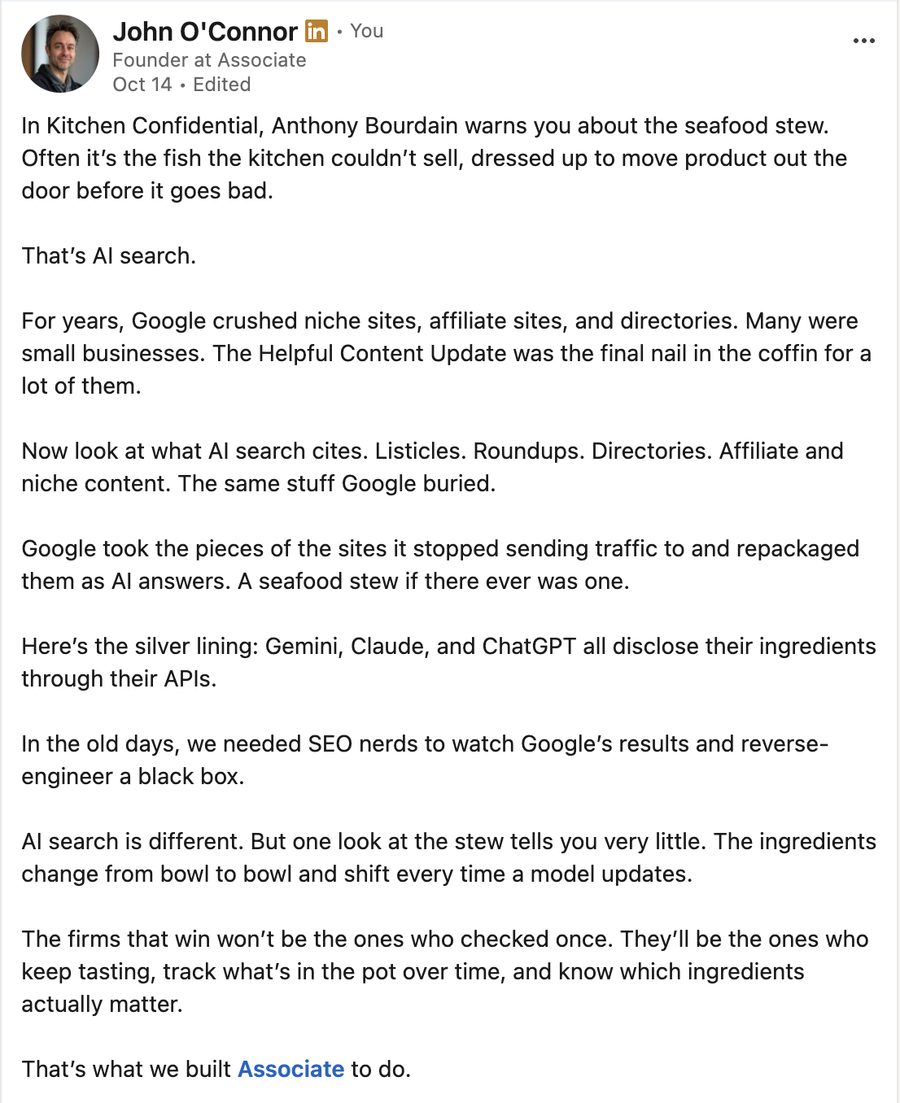
The same stuff Google buried, repackaged as AI answers.
AI labs crawl the web, and look for pockets of first hand accounts and data they can use to power local answers.
Build profiles, reviews, and reputation off Google.
It’s the old local SEO “citation” playbook with a modern twist.
Lawyers need a diverse range of reputational citations AI can draw from, but where to build is often a mystery.
That twist is found in the data the frontier labs provide via API. In the days of Google dominance, we had to spot check rankings and UI features, meaning SEOs had to manually observe and screen capture the particularities of the search results.
Today, things look different.
Rather than manually performing hundreds of AI searches and writing case study blogs, tools like Associate pull data directly from the AI labs and map for our users where they appear, what their share of AI voice is, and the ways they have fallen behind the competition.
Share of AI voice shows you the likelihood your firm will be mentioned inside a geo targeted area. The same data set we use to measure share of local voice will also map a firm against their competitors and make gaps in their citation profile visible.
One more citation source
Be a documentarian of your practice
Once you know which trusted sources the models pull from, you know where to publish. For most firms, that starts with LinkedIn.
The firm’s LinkedIn page can serve as the hub for documenting its biggest wins, verdicts and settlements alike. Each post can then become a short YouTube video. Both platforms carry more weight with AI than the firm’s own website, because the models already treat them as trusted sources.
The work is simple to describe: understand the ecosystem, then map it with good data.